
Europe's Sanitary Ware Industry: A Reckoning with Global Competitive Reality

Published December 2025 | Industry Analysis
The European sanitary ware industry faces an uncomfortable truth: policy cannot override economics. As China consolidates control over 52% of global sanitary ware exports while European governments implement protectionist measures, European enterprises are simultaneously accelerating investments in China. This disconnect between rhetoric and reality defines the industry's moment of reckoning.

The Core Problem: Structural Cost Incompetitiveness
European manufacturers confront a cost structure problem that transcends cyclical economic cycles. The fundamental issue:
Labour costs in German sanitary ware manufacturing are 2.5-3.0x higher than Chinese equivalents. When the total structural cost advantage exceeds 35-40%, tariffs become economically ineffective. The EU's current 31.5% tariff on Chinese ceramics doesn't restore competitiveness—it simply increases margins for the brief window before market dynamics reassert themselves[1].
The Data Tells the Story
- Germany's sanitary goods manufacturers: declining from 75 (2024) to 69 projected (2028)[2]
- EU imports from China (2014-2024): +101.9% growth
- EU exports to China (2014-2024): +47.0% growth
- EU greenfield investment in China (Q2 2024): €3.6 billion—a record high[3]
This last figure is especially revealing. While European governments discuss trade barriers, European enterprises are increasing capital investment in China. This tells you where competitive advantage actually lies.
What Markets Actually Reveal About Strategy
The sanitary ware market is segmenting along clear geographic lines:
Premium Segment (Western Europe)
- Dominated by: Duravit, Grohe, Hansgrohe, Villeroy & Boch
- Market share: ~25% by value
- Growth: 4-5% annually
- Competitive dynamic: Defensible through design heritage and innovation
- Key risk: Chinese brands are moving upmarket, compressing margins
Value Segment (Eastern Europe + MENA)
- Growing in: Poland (+8.1% CAGR plastic sanitary ware exports), Czech Republic (+8.7%), Turkey
- Market opportunity: 30-40% labour cost advantage versus Western Europe
- Strategic logic: Still within European regulatory frameworks while maintaining cost competitiveness
- Growth trajectory: This is where investment capital is actually flowing[4]
Commodity Segment (China)
- Market share: 52.5% of global exports and accelerating
- Growth rate: 10-15% annually in domestic consumption
- Competitive position: Unassailable for Western manufacturers
- Strategic implication: European firms have already ceded this market entirely
Why Current Policy Approaches Are Failing
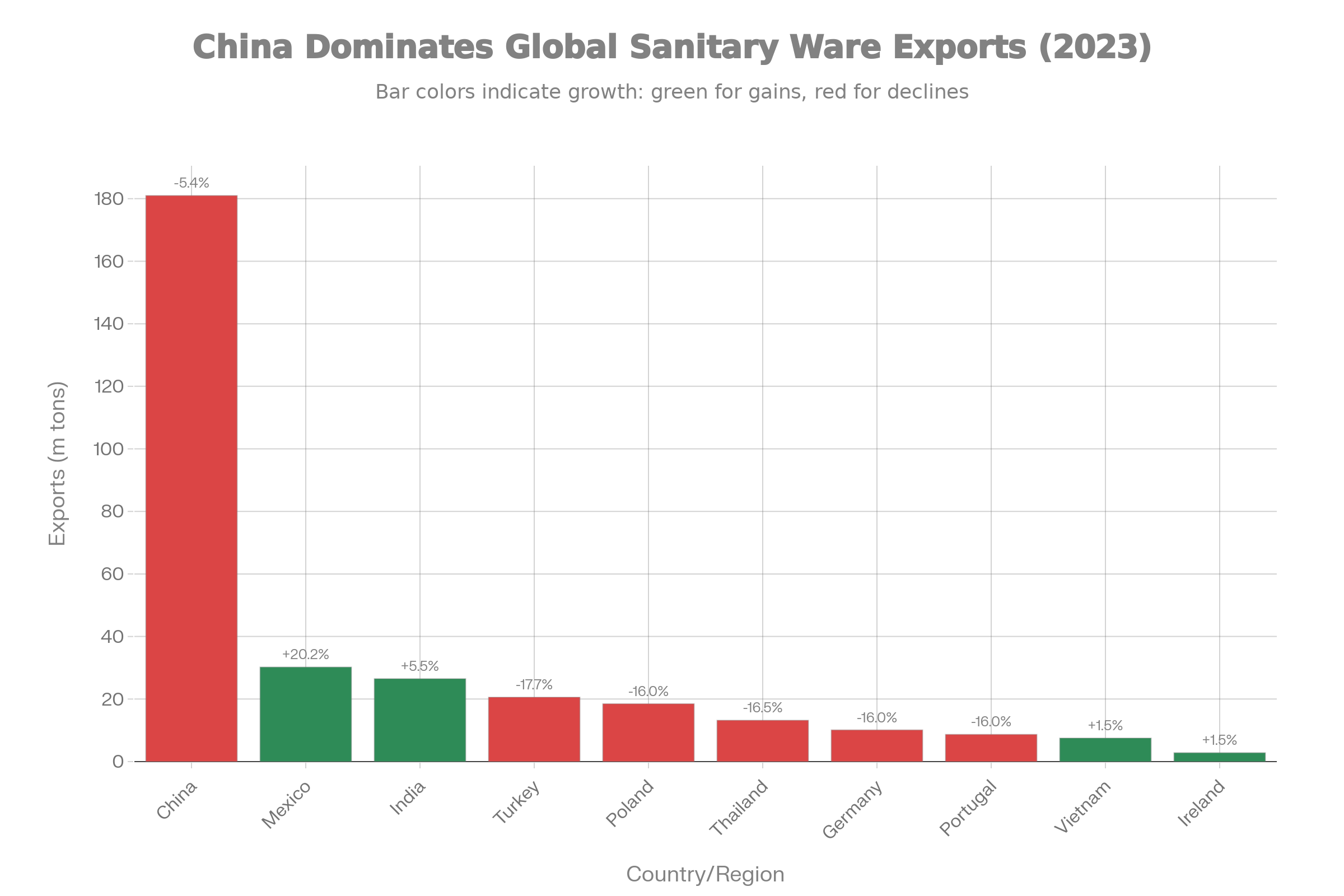
Tariff Paradox: The EU imposed 31.5% average tariffs on Chinese ceramic sanitary ware following anti-dumping investigations. The result: import volumes remained essentially unchanged. Chinese competitors absorbed the tariff costs or sourced through alternative tariff-free locations (Vietnam, Turkey). European manufacturers saw temporary margin improvement (12-18 months) followed by renewed margin compression as competitive alternatives emerged.
Capital Flight Reality: Despite protectionist policies, European firms are investing in China at record levels. This reflects a fundamental business logic: manufacturing where costs are lowest, selling where margins are highest, concentrating innovation and design where regulatory complexity justifies premium positioning. No amount of tariff rhetoric changes this economic incentive structure.
The Enterprise Vote: Large multinationals like BMW, Volkswagen, and others are increasing Chinese manufacturing investments, especially in sectors facing mature domestic demand. The message from boardrooms is clear: compete where you can compete, and relocate where you can't.
The Strategic Bifurcation: What's Actually Happening
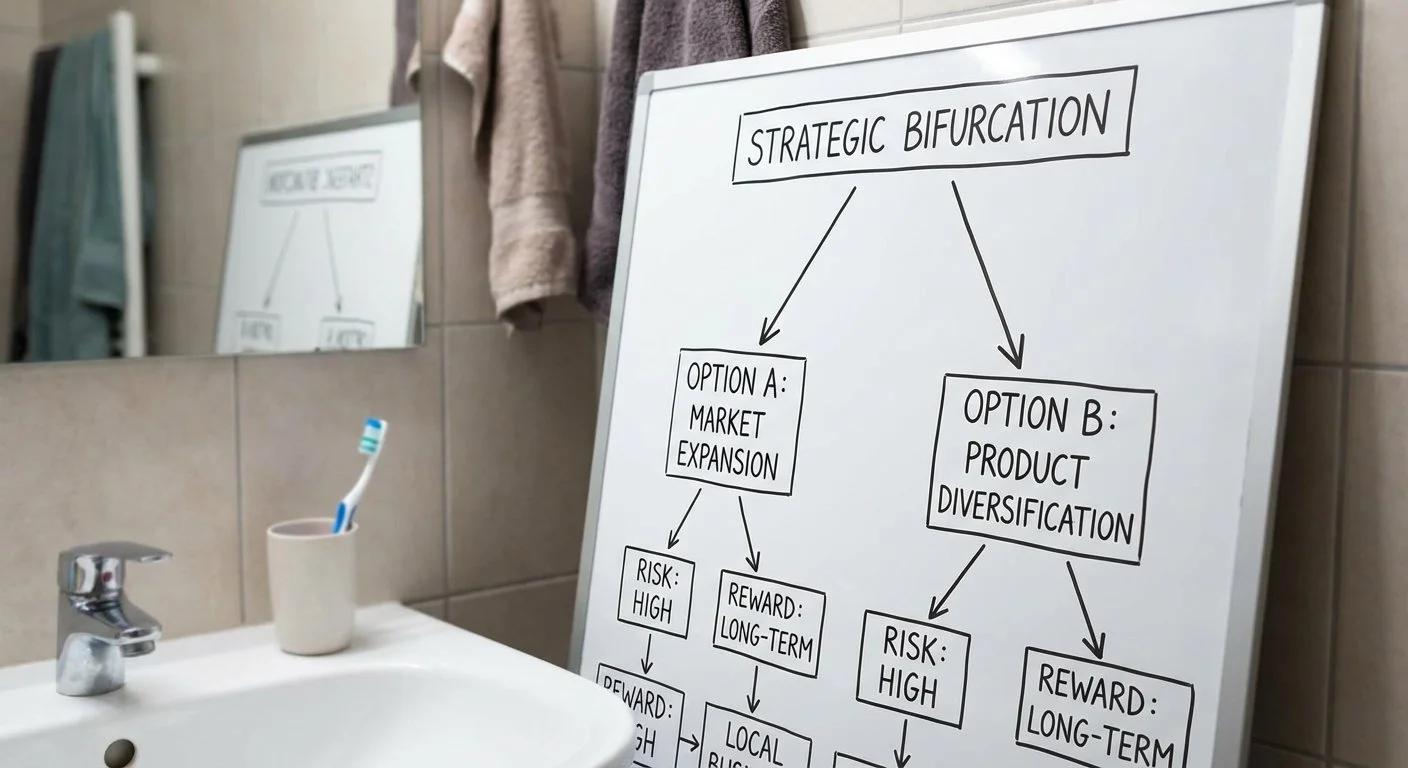
Successful European manufacturers are implementing a "dual-hub" strategy:
Hub 1: Premium Innovation (Western Europe)
- Concentrate R&D, design, and high-margin production
- Target: 40-50% gross margins
- Volume: 30-40% of total production
- Examples: Duravit's design leadership, Grohe's smart home integration
Hub 2: Value Manufacturing (Eastern Europe/Turkey/Morocco)
- Establish production in lower-cost jurisdictions
- Target: 20-30% gross margins through scale
- Volume: 50-60% of total production
- Benefit: Still within European regulatory frameworks while maintaining cost competitiveness
Hub 3: Market-Specific Production (China, Asia)
- Joint ventures or partnerships for Asian market only
- Don't attempt to compete domestically against Chinese champions (TOTO's recent retreat from China illustrates this)[5]
- Focus: Technology transfer and co-development, not manufacturing competition
This strategy is economically rational and increasingly widespread. It's also politically inconvenient because it accelerates manufacturing employment decline in Western Europe while building capacity in Eastern Europe and Turkey.
The Smart Bathroom Opportunity: Real or Mirage?
Industry optimists often suggest that "moving upmarket" into smart bathrooms provides an escape route. The data suggests otherwise:
- Chinese smart toilet market: $1.42 billion in 2024, growing 15-18% annually
- European smart bathroom market: €2-3 billion, growing 6-8% annually
- Competitive dynamic: Chinese firms (Xiaomi, Jomoo) are moving upmarket aggressively with feature-rich products at 40-60% lower prices than European equivalents
Premium Japanese manufacturer TOTO announced closure of its major manufacturing facilities in Beijing and Shanghai in 2024, citing inability to compete against domestic Chinese brands[5]. Even for technology-leading Japanese firms, defending market share in China against domestic champions is becoming economically untenable.
The implication is sobering: premium positioning is necessary but not sufficient. European firms need premium positioning in their home markets, but competing for upmarket share in Asia-Pacific against well-capitalized Chinese competitors is an increasingly challenging proposition.
What Needs to Happen: The Uncomfortable Diagnosis

European industry leaders face a choice between accommodation and fantasy:
Option 1: Managed Transformation (Realistic)
- Accept that commodity manufacturing in Western Europe is economically untenable
- Actively guide production relocation to strategic allied nations (Poland, Czech Republic, Turkey)
- Maintain European headquarters for design, innovation, distribution, and premium manufacturing
- Invest in workforce retraining and transition support
- Outcome: Smaller but defensible European manufacturing base, larger Eastern European/MENA production footprint under European ownership
Option 2: Defensive Contraction (Current Trajectory)
- Maintain tariffs and import restrictions
- Gradually lose market share as consumers access products through alternative channels or substitute offerings
- Operate at lower capacity utilization and profitability
- Eventually exit the market through gradual attrition
- Outcome: Accelerated hollowing out of European manufacturing capacity
Option 3: Premium Specialization (Viable for Select Players)
- Exit value market entirely
- Concentrate on design-led, high-margin products
- Build on heritage brands and craft traditions
- Accept 40-50% smaller addressable market
- Outcome: Niche leadership but massively reduced industry scale
For Decision-Makers: What the Evidence Suggests
Accept structural reality: The cost advantage of Chinese manufacturing in commodity sanitary ware is structural and permanent. Policy cannot overcome 35-40% cost differentials. Work with this reality, not against it.
Differentiation is mandatory: Premium positioning (design excellence, sustainability leadership, smart technology integration) is the only defensible strategy for Western European manufacturers. Mid-market cost competition is already lost.
Geographic diversification is necessary: Maintaining 100% production in high-cost Western Europe is economically unsustainable. Production must diversify to Poland, Czech Republic, Turkey, and potentially China (for Asia-Pacific markets only).
Enterprise consolidation is inevitable: The number of independent manufacturers will decline. Acquisition, strategic partnership, or market exit are the likely outcomes for mid-sized regional players.
The opportunity is in service, not manufacturing: As manufacturing becomes geographically dispersed, value increasingly accrues to innovation, brand development, distribution, and customer service—areas where European strengths remain defensible.
The Bottom Line: Market Reckoning
The European sanitary ware industry is experiencing the twilight of a manufacturing-centric business model. This is neither tragedy nor failure—it's a normal cycle of industrial economics. Countries that industrialize first eventually experience labour cost inflation that makes commodity manufacturing uncompetitive. This has happened to every developed economy.
The strategic imperative for European industry is not to prevent this transition, but to manage it intelligently.
What this requires:
- ✅ Accept geographic production diversification
- ✅ Invest in premium positioning and innovation capability
- ✅ Build supply chain resilience through nearshoring
- ✅ Support workforce transitions and reskilling
- ✅ Lead in standards and sustainability
What this doesn't require:
- ❌ Tariffs and import restrictions (they won't work)
- ❌ Resistance to production relocation (guide it strategically instead)
- ❌ Heavy investment in commodity manufacturing (that era is ending)
- ❌ Denial of competitive reality (Chinese firms dominate mid-market)
The market has spoken. The only question is whether European leadership will listen.
Sources & References
[1] EU Anti-Dumping and Tariff Data, European Commission Directorate-General for Trade, 2024-2025
[2] German Sanitary Goods Manufacturing Forecast, ReportLinker Market Analysis, 2024. https://www.reportlinker.com/dataset/35fd8e179d84f0ef4cbc371efc538db70e0e8bc3
[3] Chinese Greenfield Investment in Europe, Rhodium Group & MERICS Analysis, 2023-2024. https://rhg.com/research/dont-stop-believin-the-inexorable-rise-of-german-fdi-in-china/
[4] Europe Plastic and Iron/Steel Sanitary Ware Market Overview, IndexBox Industry Analysis, 2025. https://www.indexbox.io/blog/plastic-sanitary-ware-europe-market-overview-2024-3/
[5] TOTO Structural Reforms and Chinese Market Dynamics, KNB Italy / Industry Analysis, 2025. https://www.knb-italy.com/?p=28199
Related Reading:
- European Manufacturing Competitiveness: Structural Challenges in the Post-2020 Environment
- Supply Chain Resilience and Nearshoring Strategies
- Smart Manufacturing Technology and Industrial Competitiveness
- Tariff Effectiveness in Commodity Manufacturing Markets
Keywords & Tags: #EuropeanManufacturing #SanitaryWareIndustry #GlobalCompetition #SupplyChainStrategy #ManufacturingPolicy #ChinaCompetition #IndustrialStrategy #MarketAnalysis #CompetitiveStrategy #TradePolicy #StrategicPlanning #ManufacturingTrends #EUPolicy #EconomicStrategy #IndustryFuture
Disclaimer
The information is sourced from public channels and internal QC standards and is for reference only. If you have any objections, please contact us for deletion.