
Shower Tray Materials Compared: Acrylic, SMC, Stone Resin and Lightweight Composite
Shower trays · Materials · Buyer guide
Short answer: There is no universally “best” shower tray material. First identify the actual construction, then compare products at the same size using net kg/m², product height, approved support method, surface evidence, cutability, packaging and repair limits. Terms such as stone resin, composite and solid surface are not precise enough to make a buying decision on their own.
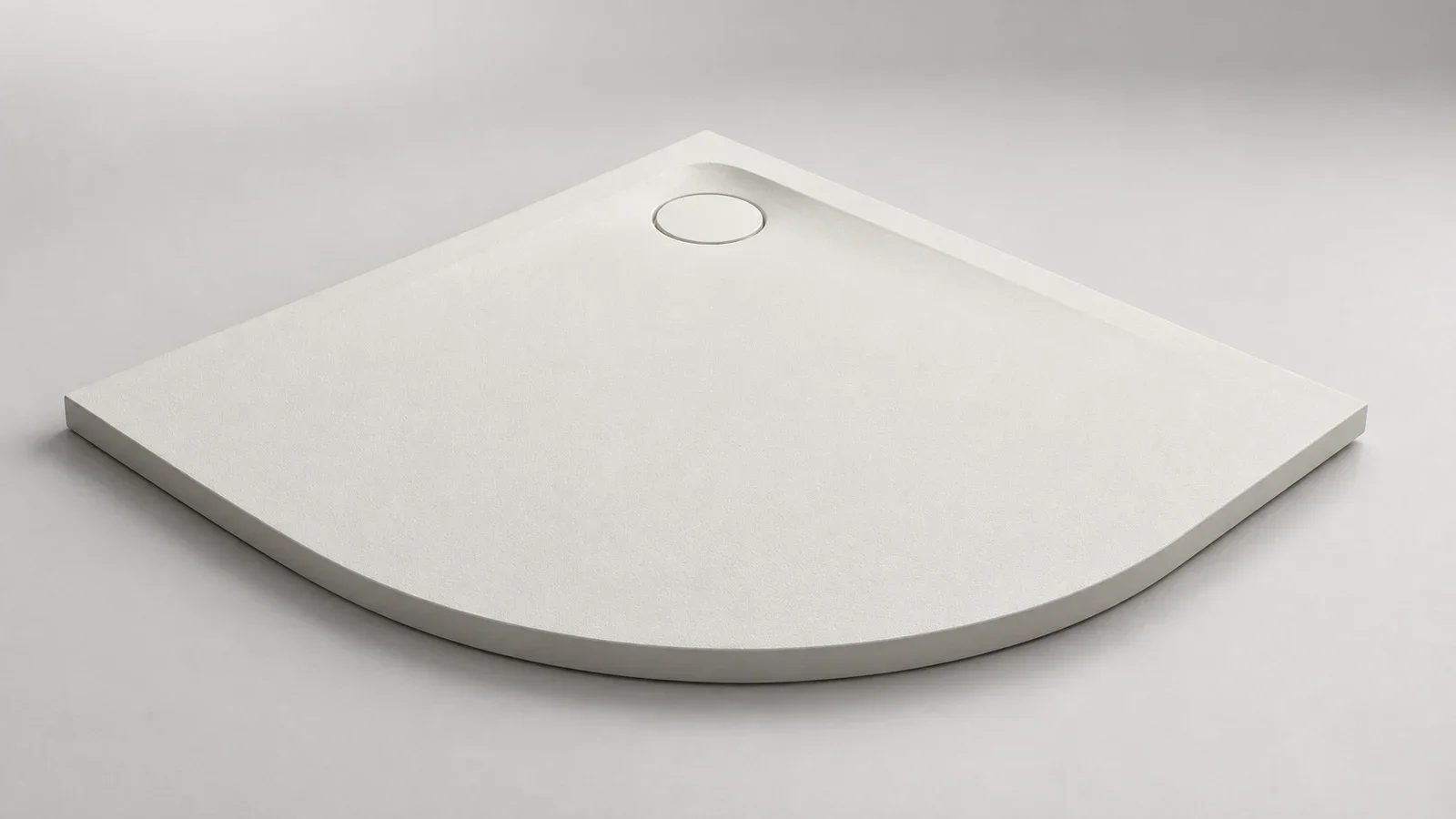
# Shower Tray Materials Compared: Acrylic, SMC, Stone Resin and Lightweight Composite
> Short answer: There is no universally “best” shower tray material. First identify the actual construction, then compare products at the same size using net kg/m², product height, approved support method, surface evidence, cutability, packaging and repair limits. Terms such as stone resin, composite and solid surface are not precise enough to make a buying decision on their own.
Classify the product before comparing the material
A finished shower tray supplies the walking surface. A tile-ready former supplies a pre-sloped substrate that still needs a waterproofing system and tile or stone finish. Mixing the two creates false comparisons: the bare former weight excludes tile, adhesive, grout and often drain components, while its final slip and cleaning performance largely depends on the installed finish.
For finished trays, use six practical families.
| Finished-product family | Construction to verify | Questions that matter before purchase |
|---|---|---|
| Sanitary acrylic | Thermoformed PMMA or another declared acrylic construction, normally with backing or reinforcement | What is the surface sheet, how is the underside supported, and which cleaner and repair instructions apply? |
| SMC / GRP | Compression-moulded sheet moulding compound or glass-reinforced resin construction | Is colour surface-only or through-body, what reinforcement is used, and what support pattern is required? |
| Acrylic-capped stone resin | Mineral-filled resin body with a separate acrylic or ABS/acrylic cap | What is the cap material and thickness, how is the edge finished, and can a damaged cap be repaired? |
| Mineral composite / solid surface | Mineral filler and resin system with a moulded or cast finished surface | Is the appearance through-body or a surface layer, what is the net weight, and is cutting explicitly approved? |
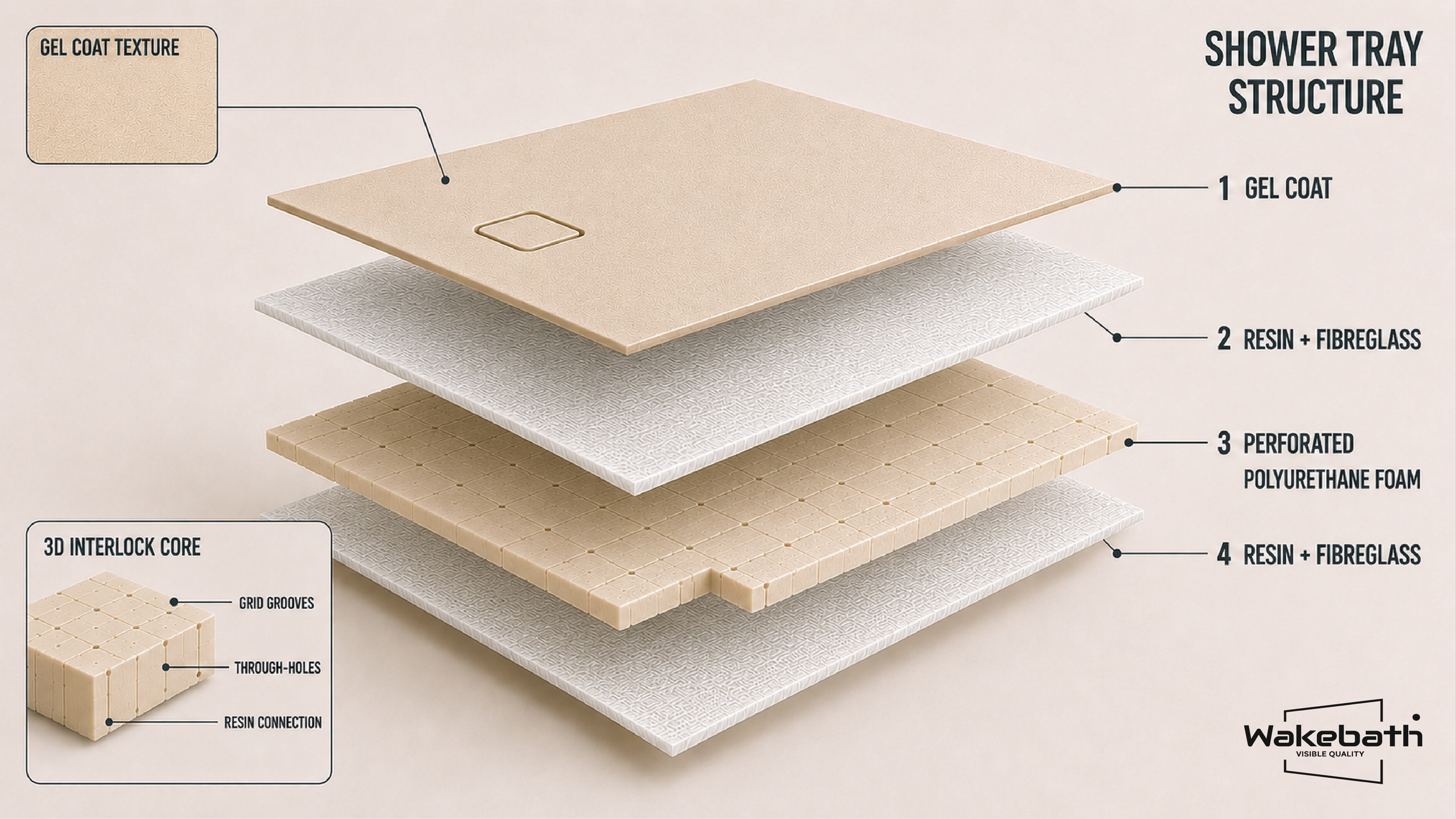
| Lightweight polyurethane composite | PU-based moulded core or body with a declared finished coating or skin | What is the exact surface system, density, reinforcement, edge treatment and approved support method? |
| Ceramic, steel enamel or slab | Fired ceramic, enamelled steel or fabricated slab construction | What are the impact/chip risks, handling method, substrate requirements and replacement implications? |
This classification describes construction, not quality. Two products in the same family can differ materially in reinforcement, surface chemistry, tooling, flatness control and installation instructions.
“Stone resin” is a category label, not a specification
The phrase can refer to an acrylic-capped mineral-filled body, a gelcoated cast composite or a different mineral-and-resin formulation. A colour name or stone texture does not reveal the structural core.
Ask the supplier for a layer description:
- Finished surface or cap.
- Structural body or core.
- Reinforcement, if any.
- Underside and support zones.
- Edge construction.
- Drain-interface construction.
If the answer is only “stone resin,” the material record is incomplete.
Compare the consequences, not marketing adjectives
| Decision field | Why it affects the project | Evidence to request |
|---|---|---|
| Net product weight | Lifting, stairs, manual handling, packaging and substrate planning | Exact SKU net weight—not carton weight |
| Product height and underside profile | Floor build-up, door threshold and drain clearance | Dimensioned section drawing |
| Support method | Load transfer and deflection risk | Current installation guide and bedding/support diagram |
| Slip evidence | Wet-use safety and tender compliance | Test method, result, surface variant and report scope |
| Cutability | Fit around walls, columns and non-standard openings | Written cutting limits, cut zones and edge-sealing procedure |
| Surface maintenance | Housekeeping cost, appearance and complaint risk | Cleaner compatibility and stain/chemical test evidence |
| Repair boundary | Whether a scratch, chip or structural crack can be treated | Approved kit/SOP, cure time and warranty position |
| Packaging | Freight damage, claim evidence and replacement exposure | Pack drawing, gross weight and route-relevant validation |
Words such as “premium,” “solid,” “anti-slip” and “repairable” do not answer these fields.
Normalize weight before calling a tray lightweight
Comparing the weight of a 760 × 760 mm tray with a 1,800 × 900 mm tray is meaningless. Use the rectangular bounding footprint:
area_m² = length_mm × width_mm ÷ 1,000,000
kg_per_m² = net_product_weight_kg ÷ area_m²
normalized_900×900_weight_kg = kg_per_m² × 0.81
Reconstructed example—not product data
| Tray | Nominal size | Published net weight | Footprint | Calculated kg/m² | 900 × 900 equivalent |
|---|---|---|---|---|---|
| Candidate A | 1,200 × 800 mm | 18.0 kg | 0.96 m² | 18.75 | 15.19 kg |
| Candidate B | 900 × 900 mm | 14.0 kg | 0.81 m² | 17.28 | 14.00 kg |
Candidate B is lighter per square metre, although the raw totals look close. The calculation still does not prove easier installation: grip points, rigidity, stairs, team lifting and packaging also matter. For quadrant or irregular trays, the length × width rectangle is only a comparison convention unless the exact surface area is available.
Five checks that prevent a false material comparison
1. Separate height terms
Record product height, rim height, installation height and material wall thickness separately. A 25 mm rim does not mean the full product is 25 mm deep, and it does not determine the space needed below the finished floor.
2. Keep net and logistics weights separate
Net weight belongs in material and handling comparisons. Gross or packaged weight belongs in transport planning. Installed-system weight may also include bedding, mortar, waterproofing, tile and drain components.
3. Name the slip test
Barefoot Classes A–C, shod ramp ratings such as R9–R13, and pendulum values are not interchangeable. Record the test method, specimen, surface, condition and result. A texture name alone is not slip evidence.
This is more than a standards-formality issue. A peer-reviewed study of ceramic surfaces found that wet conditions materially changed measured slip resistance and that surface roughness alone did not reliably predict the result. A separate human-subject study measured different friction demands when people entered and exited a bathtub/shower enclosure under dry and wet conditions. Neither study certifies a shower tray, but together they support a cautious rule: match the test method and wet-use condition to the actual surface and use case rather than inferring safety from appearance. See Sudoł et al., Materials (2021) and Siegmund et al., Gait & Posture (2010).
4. Verify cutting on the exact product
Do not infer cutability from “solid surface,” “resin” or “composite.” Cutting may expose a core, remove a finished edge, cross a reinforcement zone or alter the slope. Ask who may cut it, where, with which tool, how the new edge is sealed and how the warranty is affected.
5. Separate cosmetic and structural repair
A colour-matched spot repair does not prove that a moving crack, delamination, warped tray or damaged waste interface can be restored. It also does not automatically restore the original slip result, chemical resistance or warranty.
Material-selection workflow
Use the same sequence for every candidate:
- Fix the use case: Market, channel, installation type, target size and drain position.
- Collect primary documents: Product drawing, net weight, installation guide, surface evidence and warranty.
- Normalize comparable fields: Kilograms per square metre, product height and packaging volume at like-for-like sizes.
- Map interfaces: Substrate, waste, waterproofing, enclosure, lifting route and service access.
- Score evidence gaps: Confirmed, supplier statement pending or unknown.
- Test the commercial consequence: Stock depth, breakage, returns, installer familiarity and replacement lead time.
Buyer evidence scorecard
| Field | Candidate A | Candidate B | Release rule |
|---|---|---|---|
| Exact construction | Confirmed / Pending / Unknown | Confirmed / Pending / Unknown | No vague family name |
| Current drawing | Must match SKU revision | ||
| Net weight | Not shipping weight | ||
| Installation method | Support route is explicit | ||
| Slip evidence | Test method and surface match | ||
| Cutting SOP | Required only if cutting is proposed | ||
| Cleaning/repair | Limits are stated | ||
| Pack validation | Appropriate to route and channel |
The blank cells are intentional: this table is a procurement tool, not a pre-written verdict.
Reconstructed buying case
A distributor wants one 1,200 × 800 mm tray for both e-commerce deliveries and apartment projects. The first candidate has a familiar material label but no packaged weight, no cutting instruction and no report linking its slip claim to the supplied texture. The second has a less familiar construction but supplies a dimensioned drawing, a net and gross weight, an approved support pattern, a named slip test and a pack drawing.
The rational decision is not automatically to buy Candidate B. It is to place Candidate B further through qualification and hold Candidate A until the missing evidence is supplied. Evidence quality reduces specification and after-sales uncertainty; it does not replace sample inspection or project approval.
Build an evidence stack—not a certificate collage
Different documents answer different questions. A buyer should not treat a brand brochure, test report, standard and product listing as interchangeable proof.
| Evidence layer | What it can establish | What it cannot establish on its own |
|---|---|---|
| Law, building code or regulator guidance | The legal or compliance framework in a named market | The exact construction or performance of an unlisted SKU |
| Product standard | Test methods, declared characteristics and minimum requirements within its scope | Automatic market acceptance in every country or correct site installation |
| Accredited laboratory report | The measured result for the tested specimens and stated conditions | Performance of another texture, colour, size, production revision or installation |
| Certification or listing directory | That a named model is currently listed to a stated scheme and scope | Compliance outside that scope or continued validity after expiry or model change |
| Peer-reviewed research | Mechanisms, variables and limitations that improve technical interpretation | Product certification or a verdict on an untested commercial product |
| Manufacturer drawing, manual or EPD | Product-specific dimensions, construction, installation limits or declared impacts | A universal conclusion about the entire material family |
| Marketing page or reseller copy | A lead for further verification | Final evidence for specification or tender release |
For environmental comparisons, also check whether the declaration follows a recognised product-category method. ISO 14025:2026 sets principles for Type III environmental declarations, while ISO 21930:2017 adds core rules for construction products. An EPD can support a declared life-cycle comparison, but it does not replace mechanical, slip, installation or market-acceptance evidence.
Regional evidence lanes
- European Union and the UK: BS EN 14527:2016+A1:2018 is the principal shower-tray product standard within its scope. EN 16165:2021 contains methods for evaluating pedestrian-surface slip resistance. For products placed on the EU market, check the applicable construction-products framework and declaration route rather than assuming that a CE mark ranks materials or approves an installation.
- United States and Canada: Manufactured receptors can fall under different fixture standards according to their construction. Plastic plumbing fixtures may be evaluated to CSA B45.5/IAPMO Z124, where applicable. Confirm the code edition adopted by the jurisdiction and search the certification body’s model-level directory; an isolated cUPC or UPC logo image is not enough.
- Australia: The NCC provisions for wet-area waterproofing require preformed shower bases to be detailed and supported to prevent distortion or cracking. AS 3588 addresses shower bases and modules across several material types. Use the WaterMark Schedule of Products to determine whether a product or connected component requires certification; do not assume that every visible part of a shower base has the same WaterMark status.
- New Zealand: Building Code Clause E3 addresses internal moisture and requires relevant wet-area surfaces to be impervious and easily cleaned. The cited acceptable-solution material includes moulded-plastic, stainless-steel and tiled shower-tray details. Verify the current acceptable solution, drainage interface and product-specific evidence for the project.
The regional references above identify verification routes, not equivalence. A result accepted in one market may still need a different standard, listing, marking, installation detail or authority decision elsewhere.
Related Wakebath reading
- How to Choose a Shower Tray That Fits the Enclosure
- How to Compare Lightweight Shower Trays
- Shower Tray, Shower Base or Wet-Room Former?
- Can This Shower Tray Be Cut?
Ask for a material-fit review
Send Wakebath the destination market, tray dimensions, annual volume, installation method, target channel and any required slip or cutting evidence through the contact page. We can return a field-by-field comparison request for the proposed construction. The review should be treated as pre-qualification; final acceptance remains subject to current drawings, samples, reports and project requirements.
Primary references and evidence boundary
Regulations, codes and standards bodies
- BSI — BS EN 14527:2016+A1:2018, Shower trays for domestic purposes — Standard status and scope; full requirements require authorised access. Accessed 2026-09-21.
- BSI — BS EN 16165:2021, Determination of slip resistance of pedestrian surfaces — Test-method scope; it does not make unlike classifications interchangeable. Accessed 2026-09-21.
- EUR-Lex — Regulation (EU) 2024/3110 — EU construction-products framework and declaration/marking context; transition and product applicability require market-specific review. Accessed 2026-09-21.
- IAPMO — formal interpretation of CSA B45.5/IAPMO Z124 — Direct evidence that the standard addresses plastic plumbing fixtures and shower-base threshold interpretation; check the adopted edition and complete scope. Accessed 2026-09-21.
- Australian Building Codes Board — NCC wet-area waterproofing and preformed shower bases — Installation-interface and support requirements in the cited NCC edition. Accessed 2026-09-21.
- New Zealand Building Performance — E3 Internal Moisture and Building CodeHub — AS 3588 — Wet-area performance route and the cited shower-base/module standard. Accessed 2026-09-21.
- ISO — ISO 14025:2026 and ISO 21930:2017 — EPD principles and construction-product core rules; environmental declarations do not certify installation or slip performance. Accessed 2026-09-21.
Certification and listing bodies
- IAPMO R&T — marks of conformity guidance and certification-directory resources — Use the model-level listing and current scope, not a logo copied into marketing material. Accessed 2026-09-21.
- WaterMark — certification explanation and Schedule of Products — Australian certification route for products within the schedule; connected components may have separate obligations. Accessed 2026-09-21.
Peer-reviewed research and safety guidance
- Sudoł et al. — What Makes a Floor Slippery?, Materials 14(22), 7064 — Experimental evidence that wet condition, surface finish and test method affect slip results and that roughness alone is not a sufficient proxy. Accessed 2026-09-21.
- Siegmund et al. — Utilized friction when entering and exiting a dry and wet bathtub, Gait & Posture 31(4) — Human-subject evidence about dry/wet friction demands at a bathtub/shower enclosure; not a product-certification study. Accessed 2026-09-21.
- UK Health and Safety Executive — assessing the slip resistance of flooring — Practical guidance on interpreting floor slipperiness and pendulum testing; apply only within its stated context. Accessed 2026-09-21.
Manufacturer evidence—product-specific and secondary
- Roca — STONEX material, Just Trays — product ranges, Villeroy & Boch — Quaryl and Kaldewei — steel-enamel EPD — Examples of distinct proprietary constructions; none defines an entire generic material family. Accessed 2026-09-21.
- Duravit — acrylic baths and shower trays EPD — Official construction and environmental evidence for the declared product group, not for all acrylic products. Accessed 2026-09-21.
- Schlüter — KERDI-SHOWER-T/-TS/-TT and JACKOBOARD Aqua — Official examples showing why tile-ready EPS/XPS substrates must be separated from finished trays. Accessed 2026-09-21.
Evidence boundary: This article provides a classification and due-diligence method. It does not certify a material family, claim identical performance within a family or select a product without exact-SKU documents and destination-market review.